Anatomy of a mechanical watch
An automatic watch has no battery. A coiled spring stores the power, a train of gears counts it out, and a tiny wheel swinging eight times a second keeps the time. Scroll down to take one apart, part by part. Scroll back up to put it together again.
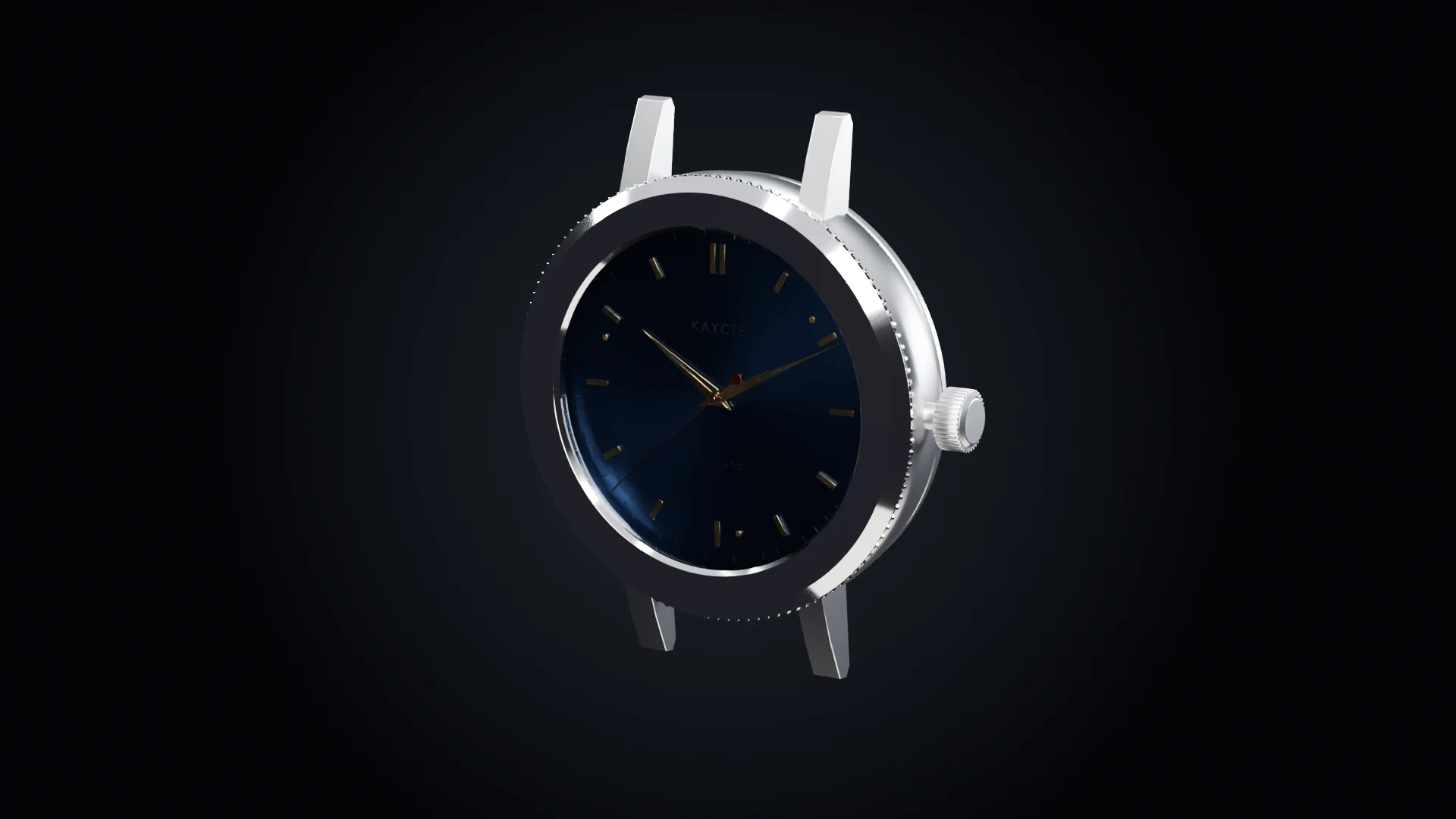
Kaycee Automatic · 40 mm
Scroll to take it apart
One part at a time, from the crystal down to the caseback.
The 13 parts
- 01Sapphire crystal. Synthetic sapphire, 9 on the Mohs scale. Only diamond will scratch it.
- 02Polished bezel. Holds the crystal and sets the profile of the case. The coin edge gives your fingers grip.
- 03Hands. Hour, minute and centre seconds, set to 10:10, the pose watch photographers use so the hands frame the dial.
- 04Sunburst dial. The brushing radiates from the centre, so a band of light sweeps across the dial as your wrist turns.
- 05Main plate. The movement's foundation. Every wheel pivots between this plate and the bridges above it.
- 06Mainspring barrel. A coiled steel spring stores the power. The toothed drum turns slowly as the spring lets down, giving about 40 hours of reserve.
- 07Gear train. The centre, third and fourth wheels step the barrel's slow turn up to one revolution a minute at the fourth wheel.
- 08Balance & hairspring. The regulator. It swings back and forth 8 times a second (28,800 vibrations an hour), and that rate sets the watch's accuracy.
- 09Escapement. The escape wheel and pallet fork release the train one tooth at a time. This is the tick you hear.
- 10Bridges. They hold the upper pivots of each wheel in ruby jewels, finished with Geneva stripes and blued screws.
- 11Oscillating rotor. Swings with every movement of your wrist and winds the mainspring. This is what makes the watch automatic.
- 12Case, lugs & crown. The case middle carries the strap lugs. The crown winds the spring by hand and sets the time.
- 13Display caseback. A second sapphire window, so you can watch the movement work from the back.
How it was made
The watch was modelled entirely in code with Blender’s Python API: every wheel, tooth, jewel and screw is generated from a script, not sculpted by hand. Blender’s Cycles renderer then traced 120 frames of the teardown for wide screens and another 120 for phones, with the camera pulling back as the stack grows.
The page plays those frames against your scroll position, blending neighbouring frames so the motion stays smooth. The numbered pins aren’t placed by eye: Blender exported where each part sits on screen in every frame, so the labels stay locked to the metal.